

This is Part 6 of our series on Upskilling in Engineering.
In the previous article, we examined the cost of poor scaffolding and how it applies to various stages in an engineer’s career. Now we are going to try to apply what we have discussed in all previous articles and give practical implementations. These ideas are meant to be a starting point and kickoff discussion. Every team, project, and person is different therefore no single framework can apply universally. But bearing in mind the concepts we have covered – Scaffolding, Zone of Proximal Development, Student- and Teacher-Centered Learning, and more – can help inform our processes for helping our teammates and ourselves grow.
Identifying Amenable Projects
One of the first steps to providing proper scaffolding and enabling growth is identifying projects which allow for either Teacher- or Student-Centered Learning. Some projects may not have the time, budget, or general latitude to allow for mistakes. In those cases, people assigned to the project may just need the proper experience and skillsets at the outset for the project to succeed.
Generally, though, most projects have some space to allow for learning and rarely are the perfect people with the ideal skillsets all available at the exact right time. For example, in Industrial Automation, usually there is enough bandwidth on a project for a junior engineer to work on screens for a time, receive feedback from a more experienced engineer, and correct their work.
Continuing the example, putting the junior engineer in the Zone of Proximal Development can vary depending on the project, even if there is latitude for learning. Teacher-Centered Learning may be appropriate when there are technical details that need to be monitored more closely by the Technical Lead on the project. Or in the case where there is more time or lower technical requirements, the junior engineer could work with others to overcome difficulties before going to the Technical Lead and still have time to incorporate any feedback.
Projects should also be evaluated for the opportunity for more direct learning and growth. For example, promoting someone to Technical Lead for the first time. Again, some projects may not have the bandwidth to allow for someone to be a Technical Lead for the first time. Just the sheer size of a project may make that prohibitive. But appropriately sized and scheduled projects can be excellent opportunities for engineers to upskill.
Identifying projects which are good candidates to enable learning may not seem particularly difficult at first glance, and it usually is not. But just because it seems easy to tell, does not mean doing the identification should be neglected. Taking the time to examine a project for the opportunity to teach either a technical skill or soft skill will help keep teaching in the forefront of people’s mind and can help people stay on the lookout for opportunities to upskill themselves and their peers.
A Possible Implementation: Technical Mentor
 Whether Teacher- or Student-Centered Learning is pursued for a project, having a Technical Mentor can help the student. Highly technical managers can help fill this role or this could even seem to be fulfilled by engineering reviews, but this is more focused and less formal than either of these. Managers may not have the bandwidth to be deeply involved in the details of a project and engineering reviews may be too big of a stage for smaller questions or corrections.
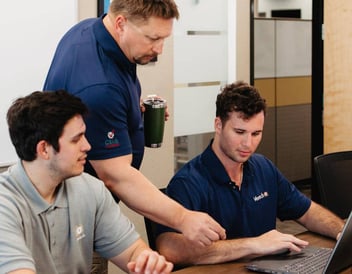
A Technical Mentor could be assigned to a more junior engineer with the explicit intent of developing their skills in some area. For example, if the junior engineer has been tasked with developing a SCADA architecture for the first time, the more experienced engineer can be there for guidance and feedback. Even at a technical lead level, having someone to informally ask questions about how to approach a project is much less intimidating than a full engineering review, and it gives feedback directly much faster meaning any issues can be quickly identified and corrected if necessary.
Technical Mentors could even be a boon for more experienced engineers. Maybe someone is lacking in a particular programming area and wants some guided practice. Or perhaps the project size is bigger than they have taken on before, so having someone equally or more experienced to talk through problems with could be helpful. Having a consistent technical mentor means the mentor can understand more of the nitty-gritty in the area the mentee is working on. They are therefore able to give more direct, quicker feedback to help the mentee grow and learn.
A Possible Implementation: Engineering Reviews
Regular engineering reviews are another route for monitoring projects and providing guidance. These can involve several people and may be a bit more formal. However, using these must be intentional and should never be used as a place to pick someone apart. Instead, it can be a place for providing honest feedback on the work being done and helping to guide the person towards success.
The rigor, frequency, and level of these reviews can vary. If someone is having their architecture reviewed, the reviewers should be looking to help shore up the plan, not necessarily providing their ideas on what they think it should be. The same applies for Technical Leads going through the architecture and beyond. While the reviewers should be looking for holes, ultimately, they are there to help the person find and solve problems, not impose their ideas on them.
Having this in mind takes great intentionality to make sure the person being reviewed feels supported and encouraged rather than belittled. But these can be a phenomenal way to get a lot of feedback quickly from a variety of sources. Unlike the Technical Mentor, reviewers may not know the day-to-day of what the person being reviewed is doing, but sometimes that can help bring to light new ideas to make a project even stronger.
Keep it in the Zone
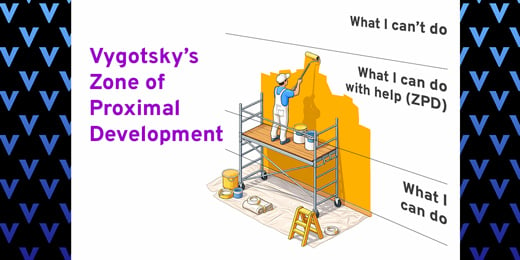 We all want to see our peers grow, learn, and succeed. Across this series we have covered a variety of topics to enable that by working to keep everyone in the Zone of Proximal Development. Inspired by people who study teaching for a living, teachers, we have applied these concepts to the professional work environment. Zone of Proximal Development, Scaffolding, Intersubjectivity, Gradual Release of Responsibility, Teacher- and Student-Centered Learning can all be leveraged when working to upskill one another.
Unfortunately, there are no hard and fast rules for accomplishing upskilling and perfectly staying within the Zone. But by bearing all these concepts in mind and continually keeping them in the forefront, we can work to achieve it. Everyone should be able to stay in this Zone at various stages of their careers, and everyone should feel they have the Support and Scaffolding to get there.


Comments