

In a previous article, we examined how infrastructure issues could lead to downtime. The physical components, software, networking and power supply that degrade over time. Once you’ve addressed those potential issues, you’re good to go, right?
Well, sometimes manufacturing outages are not caused by catastrophic equipment failure. They are caused by operational blind spots that make systems harder to understand, maintain, and troubleshoot.
Disconnected data, undocumented changes, overloaded operators, and knowledge gaps create environments where small problems escalate into major downtime events. As industrial operations become more connected, these visibility and process issues are becoming just as important as hardware reliability.
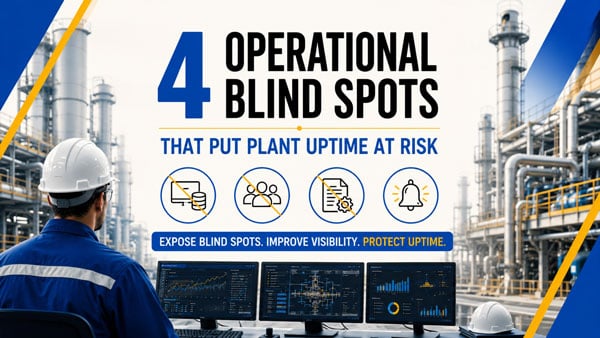
Here are four operational blind spots that commonly contribute to downtime in legacy plants.
Poor OT/IT Convergence
What is OT/IT convergence in manufacturing?
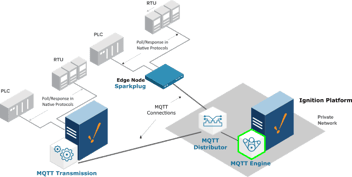
OT/IT convergence refers to securely connecting operational technology systems such as PLCs and SCADA with enterprise IT systems including ERP, MES, and analytics platforms.
Many facilities still operate with disconnected systems across the plant and enterprise.
SCADA systems, MES platforms, historians, ERP software, and spreadsheets often exist in isolated silos. As a result, operators and supervisors manually move information between systems. This issue is compounded in multi-site operations that may be geographically spread out.
This creates:
- Reporting delays
- Data inconsistencies
- Manual entry errors
- Limited production visibility
- Incomplete downtime analysis
Without integrated architecture, plants struggle to understand real-time operational performance.
Modern OT/IT convergence strategies improve visibility by securely connecting production systems with business systems. Unified data architecture help manufacturers reduce manual processes and gain faster operational insight.
Tribal Knowledge Dependency
In many plants, critical operational knowledge exists only in the minds of a few experienced employees. The urgency of this risk is intensifying as experienced workers exit the workforce in growing numbers. A joint study by Deloitte and The Manufacturing Institute projected that the United States manufacturing sector could face up to 2.1 million unfilled jobs by 2030, driven largely by the retirement of experienced baby boomer workers. The same research found that roughly one quarter of the current U.S. manufacturing workforce is 55 years of age or older, placing a substantial share of institutional knowledge at near-term departure risk.
When those individuals retire, resign, or are unavailable during an outage, troubleshooting becomes significantly more difficult.
Why is tribal knowledge risky in industrial plants?
When critical operational knowledge exists only with a few employees, outages become harder to troubleshoot if those individuals are unavailable.
Common examples include:
- Undocumented PLC logic
- Missing network diagrams
- Informal troubleshooting procedures
- Custom workarounds known only to specific technicians
Tribal knowledge creates a hidden operational risk because recovery time becomes dependent on individual availability rather than documented processes.
Reducing this risk requires:
- Accurate documentation
- Cross-training
- Maintainable code standards
- Knowledge transfer procedures
- Consistent operational standards
Plants that fail to capture institutional knowledge often discover the problem during a critical outage. Part of the strategy is to improve monitoring capabilities to shift the response from heroic repairs to incremental maintenance, making for more repeatable and trainable routines.
Configuration Drift
Control systems naturally evolve over time. Operators adjust setpoints. Technicians add bypasses. Engineers modify timers or alarms to solve immediate production issues.
The problem is that many of those changes are never documented.
Over time, systems drift further away from their original design and documentation.
Configuration drift creates major problems during troubleshooting because:
- Drawings no longer match reality
- Backups may be outdated
- Temporary fixes become permanent
- Recovery efforts restore incorrect configurations
This issue becomes especially severe in facilities with multiple shifts, contractors, or years of undocumented modifications. If you have multiple sites, this is further compounded by facilities that have grown independently without standardized databases or processes.
What is configuration drift?
Configuration drift occurs when undocumented changes gradually move systems away from their original design, creating troubleshooting and recovery challenges.
Strong change management practices reduce drift by ensuring that updates, backups, and documentation stay aligned with the actual production environment.
Alarm Management Failures
When everything becomes an alarm, operators stop paying attention to alarms altogether.
Poorly configured alarm systems often generate hundreds or thousands of notifications during process upsets. Critical warnings become buried in nuisance alarms, creating confusion during already stressful situations.
Alarm floods commonly occur during:
- Communication failures
- Equipment faults
- Startup and shutdown sequences
- Process instability
Over time, operators become desensitized to constant alerts.
Why is alarm management important?
Poor alarm management overwhelms operators with excessive alerts, making it harder to identify and respond to critical operational issues.
Effective alarm management focuses on presenting actionable information instead of noise. This includes:
- Alarm rationalization
- Prioritization strategies
- Suppression and shelving
- Historical alarm analytics
- Identification of chattering alarms
Well-designed alarm systems improve situational awareness and help operators respond faster during abnormal conditions.
Why Operational Visibility Matters
Legacy plants often focus heavily on hardware reliability while underestimating the operational side of downtime risk.
In reality, many outages become prolonged because teams lack visibility into what changed, where the problem originated, or how systems are interconnected.
Disconnected data, undocumented modifications, and inconsistent processes all increase recovery time when failures occur.
As manufacturers continue modernizing operations, operational visibility and maintainability are becoming critical components of uptime strategy.
Improving operational awareness does not always require major capital projects. In many cases, documentation improvements, better alarm strategies, and stronger OT/IT integration can measurably reduce unplanned downtime exposure. Benchmarking research by McKinsey & Company on connected manufacturing facilities has documented downtime reductions of 30 to 50 percent through digital transformation, while also realizing improvements in productivity, throughput and cost of quality.
Expose the Blind Spots
Operational blind spots don't announce themselves. They accumulate quietly in undocumented workarounds, aging alarm systems nobody's rationalized in years, and institutional knowledge walking out the door with retiring technicians. By the time most plants feel the impact, they're already in recovery mode. The good news is that none of these problems require a greenfield project to address. Improving documentation practices, aligning your OT and IT environments, and getting your alarm systems under control are achievable steps that meaningfully reduce your exposure to unplanned downtime. If you're not sure where your biggest blind spots are, that's exactly the conversation Vertech was built for. Let’s get in touch.


Comments