

Not every equipment failure turns into a major outage. But if you're reading this, there's a good chance you had a close call or are “just asking for a friend.” Either way, you’re wise to try to avoid a miserable stretch of downtime.
In industrial environments, the gap between a brief interruption and several lost production days rarely comes down to the equipment that broke. It almost always comes down to everything that wasn't ready when it did.
Legacy automation can run quietly for years — sometimes decades — without much complaint. The trouble is, 'without much complaint' has a way of ending without warning. When it does, every gap in your documentation, backup coverage, or spare parts inventory shows up at once.
Resilience Gaps That Commonly Extend Downtime in Industrial Facilities
Missing or Outdated Backups
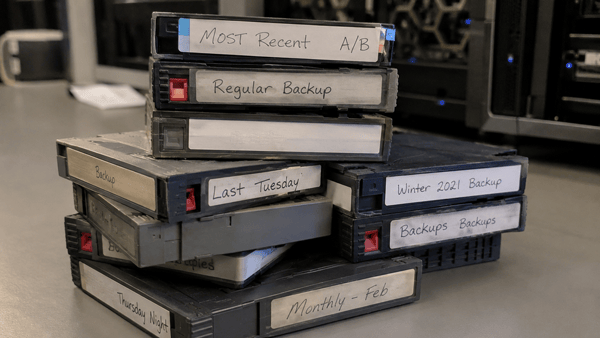
Many plants assume their PLC programs, HMI configurations, and server images are safely backed up somewhere. Then a controller fails and nobody can locate a current version. Backup gaps are a known ICS resilience risk. NIST’s manufacturing ICS guidance emphasizes protecting system integrity and recovery capability for industrial control environments.
Without verified backups, recovery turns into an archaeological dig: reverse engineering logic that should have been saved, reprogramming from memory, and reconstructing configurations that someone definitely meant to document at some point.
Why are backups important in industrial control systems?
Backups allow plants to quickly restore PLC programs, HMI configurations, and servers after failures instead of rebuilding systems manually.
In some cases, plants lose weeks attempting to restore systems that could have been recovered in hours with proper backup procedures.
Effective backup strategies include automated scheduled backups, version-controlled program storage, offsite backup retention, and regular restoration testing.
An untested backup isn't a backup. It's an optimistic file sitting on a server, waiting to let you down at the exact moment you can least afford it.
Environmental Monitoring Gaps
Industrial automation equipment is built to last — but not to quietly cook in a cabinet while the AC runs a few degrees warm for six months.
Electrical rooms, server closets, and control panels are vulnerable to excessive heat, water intrusion, humidity, HVAC failures, and condensation and corrosion.
By the time someone physically finds the problem, the damage has often been accumulating for days. Equipment that looked fine last week has been running at the edge of its thermal limits the whole time.
Why should plants monitor environmental conditions?
Temperature, humidity, and water intrusion can damage industrial IT infrastructure long before operators physically notice a problem.
Where environmental monitoring is limited to manual inspection, heat, humidity, or water intrusion can go unnoticed until equipment is already affected.
Modern monitoring systems allow facilities to continuously monitor room temperature, humidity levels, water presence, and HVAC performance.
Integrating environmental monitoring into SCADA systems helps operators respond to problems before they damage critical infrastructure.
Parts Obsolescence
That drive that's been quietly running your line for a decade may have been discontinued years ago. You just haven't needed to replace it yet — which is also why no one's checked.
Parts obsolescence is invisible by design. It only surfaces when something fails and the distributor tells you the part is no longer made, or the only available units are refurbished and of uncertain quality.
Plants then face long lead times, emergency redesigns, unverified refurbished parts, and production delays while equipment is sourced.
What is industrial parts obsolescence?
Parts obsolescence occurs when manufacturers discontinue critical industrial hardware, making replacement components difficult or impossible to source.
Many organizations underestimate how quickly supply chain issues and end-of-life announcements can affect operational reliability.
Effective obsolescence management includes lifecycle tracking, spare parts strategies, criticality assessments, and planned migration roadmaps.
Proactive spare planning is typically far less expensive than emergency downtime response.
Inadequate Cybersecurity
Most legacy industrial control systems were built around one core assumption: they would never touch an outside network. That was a reasonable position in 1998. It is not a reasonable position today.
Today, most facilities operate with some level of remote access, enterprise integration, or internet-connected infrastructure.
Without proper security controls, legacy OT systems become vulnerable to malware, ransomware, unauthorized remote access, lateral movement from IT networks, and accidental operational disruption.
Cybersecurity incidents can dramatically increase downtime because recovery often involves both operational restoration and forensic investigation.
How does cybersecurity affect manufacturing uptime?
Cybersecurity incidents can disrupt production systems, delay recovery efforts, and expose industrial networks to operational downtime.
Industrial cybersecurity strategies should include network segmentation, role-based access control, monitoring and logging, secure remote access, backup protection, and documented recovery procedures.
As more manufacturers connect operations to enterprise systems, cybersecurity resilience becomes directly tied to uptime.
Why Recovery Readiness Matters
Every plant fails eventually. When something breaks, the plants that recover fastest are the ones whose teams already know exactly what to do.
Plants with tested backups, environmental monitoring, spare part strategies, and cybersecurity protections recover faster and experience less operational disruption.
The challenge with legacy environments is that many recovery weaknesses remain hidden until a crisis occurs. By then, the cost of downtime is already escalating.
Resilience planning is one of those investments that feels like overhead but it makes all the difference between manageable incident and a full production crisis. The goal isn't to prevent failure. It's to make sure that when something breaks, your team already knows what to do next.



Comments