

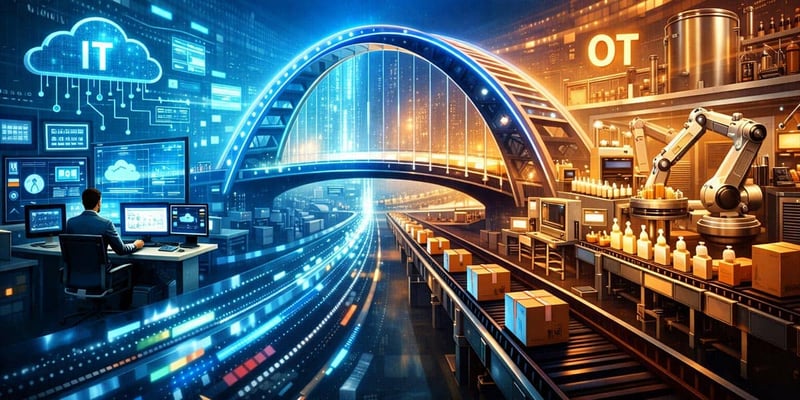
In many food and beverage manufacturing facilities, Information Technology (IT) and Operational Technology (OT) still operate in separate worlds.
IT focuses on enterprise systems, cybersecurity, and data management.
OT focuses on production equipment, PLCs, control systems, and uptime on the plant floor.
Both are critical—but when these two groups operate in silos, it creates a gap that slows innovation, complicates integration, and increases risk.
Why the IT–OT gap matters more today
Food and beverage manufacturers are rapidly adopting more connected technologies, including:
- Industrial IoT and smart sensors
- Cloud-connected production systems
- Advanced analytics and AI-driven optimization
- Digital traceability and quality systems
- Expanded cybersecurity protections
These initiatives require tight collaboration between IT and OT teams. Without it, companies often experience:
- Delays in digital transformation projects
- Security vulnerabilities between enterprise and plant networks
- Limited visibility into real-time production data
- Integration challenges between ERP, MES, and control systems
Why the Gap Exists
The divide between IT and OT developed over decades.
Operational environments were built for reliability, safety, and uptime, often using specialized systems that remained unchanged for years. Meanwhile, IT evolved rapidly around software platforms, networking, data, and cybersecurity.
As a result, the two groups often operate with different priorities:
| IT priorities | OT priorities |
|
|
Both perspectives are valid—but alignment is essential as plants become more connected.
How manufacturers are closing the gap
-
Create cross-functional collaboration
Breaking down silos between plant engineering, automation teams, and IT is key to successful digital initiatives.
-
Develop a unified cybersecurity strategy
Industrial networks are increasingly targeted by cyber threats. Security must extend from enterprise systems all the way to the production line.
-
Standardize data architecture
Connecting ERP, MES, historians, and plant floor systems requires a clear data strategy and scalable infrastructure.
-
Improve industrial connectivity and visibility
Modern architectures enable production data to move securely from machines to business systems in real time.
-
Align on a digital transformation roadmap
Technology initiatives should support both operational goals and business outcomes.
Where Vertech can Help
Successfully bridging the IT–OT gap often requires both operational expertise and deep technology experience. This is where organizations like Vertech help food and beverage manufacturers accelerate their initiatives.
Vertech works with manufacturers to:
- Design and implement secure IT/OT network architectures
- Integrate plant floor systems with enterprise platforms (ERP, MES, data platforms)
- Modernize industrial automation and control systems
- Improve data visibility and operational intelligence
- Strengthen industrial cybersecurity posture
By combining expertise in automation, industrial networking, systems integration, and digital transformation, Vertech helps manufacturers move from disconnected systems to connected, data-driven operations.
The Opportunity Ahead
The IT–OT gap isn’t just a technical issue—it’s a strategic one.
Manufacturers who successfully bridge this divide unlock powerful capabilities:
- Real-time production visibility
- Faster operational decision-making
- Improved quality and traceability
- Reduced downtime
- Stronger cybersecurity
- Ongoing managed services to keep industrial networks secure and up to date
In an industry where reliability and efficiency are critical, the organizations that align IT and OT will be best positioned to innovate and compete.
Want to learn more? Download your copy of 5 Practical Steps For Managing Critical Control Networks.



Comments